
Inception into J-Space
A descent through a speech model—from readable words at the surface to distributed acoustic patterns below, and what happened when I tried planting an anchor · July 2026 · about 8 minutes
What I love about neuroscience is that its most interesting puzzles often begin with what we cannot directly observe. We cannot dissect a living human brain for an experiment, and we do not yet have a technique that can record every neuron at once while someone performs a language task. Researchers therefore have to design experiments and build theories from limited, indirect evidence.
Studying large language and speech models has started to look a little like psycholinguistic research. With models, we can access activations throughout their layers, but we do not have an automatic way to connect those numbers with what is actually happening. There is simply more information than any researcher’s working memory can handle. We need a tool that consolidates it into something workable.
That is why I found Anthropic’s Jacobian Lens so interesting, and why I built the Audio Jacobian Lens. I have been using this modified version to inspect Whisper layer by layer. It lets us look into a model’s internal computation—not chain of thought, where a model speaks something aloud, but intermediate states the model never outputs.
You can now try the Audio Jacobian Lens on your own examples in the Hugging Face Space.
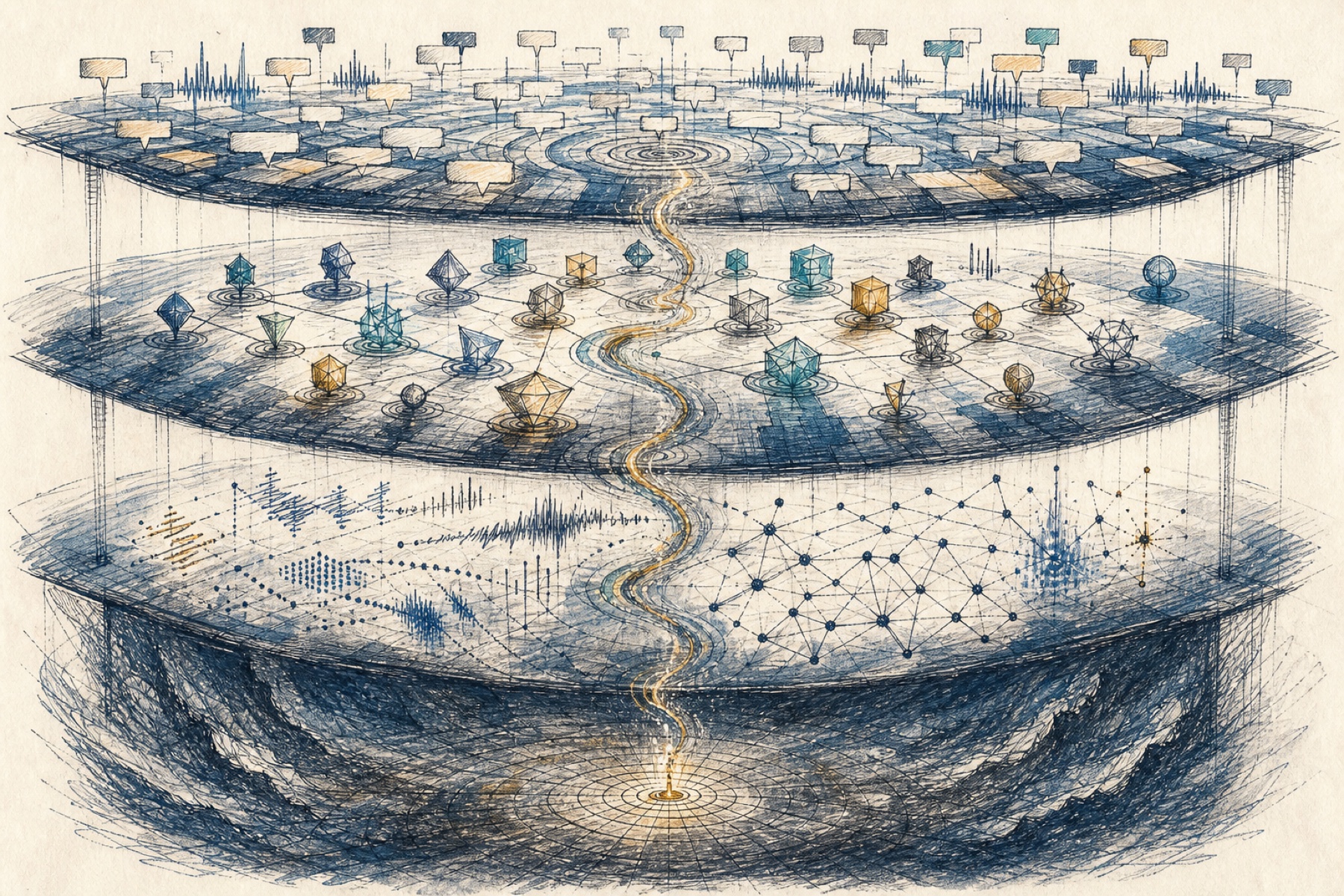
The more I use it, the more I keep thinking about Inception.
In the movie, you enter one dream, then another inside it, and then another. Near the surface, things still look familiar. Deeper down, an object can become a projection, several objects can express something none means alone, and one small anchor can reorganize the levels above it.
As I inspect Whisper, three observations make the Inception metaphor feel especially fitting: a word association that appears in an early LM-head readout before the final answer settles, a phonetic pattern that becomes readable only as a constellation of cues, and an anchor that changes what returns to the surface—like planting an idea in Inception.
In plain terms, the J-lens asks: which output-vocabulary directions become readable from an intermediate state? It turns an unnamed activation into clues that I can compare across layers, time, and interventions.
This brings me back to psycholinguistics. We used reaction time, priming, ambiguity, and mistakes to infer language processes we could not inspect directly. Inspecting a model is both similar to and different from doing psycholinguistics. We are still trying to infer hidden language processes from observable patterns, but now nearly every activation is accessible. The difficulty is not simply seeing too little; it is making sense of too much. Most activations have no name, so we still need experiments that make their patterns readable.
At the surface, now. One layer down, who.
I played Whisper a recording in which the speaker asks:
Where is my brother now?
The final word is now, but its full-vocabulary rank moves through the decoder like this:
#6,319 → #7,237 → #3 → #1
At the first plotted decoder layer, who is already the Explorer’s top displayed candidate—#4 across the full vocabulary, then #1 at the next layer—while now is still thousands of places down the list.
now. Select another cell to inspect its saved candidates, or open the full example.To me, brother → who looks like the decoder using a familiar word association as a hint before the answer settles. That alone is not new: language models learn from patterns of co-occurrence and can reproduce some of the same word associations we observe in human behavior. What interests me is how that text-learned expectation competes with the acoustic cue arriving from the encoder. Across the layers, the model has to determine how much to trust what it seems to hear and how much to trust what its training history says is likely. Watching that balance shift is what sends me farther from the language-model head, into the encoder.
Deeper down, words stop behaving like words
The encoder works with short acoustic states. One position does not have to map neatly onto a complete word, so reading only its highest-ranked token may be the wrong approach.
The lens still shows vocabulary-aligned directions because vocabulary is a coordinate system humans can read. But perhaps the better question is not, “Which word does this token mean?” It is: how do familiar directions combine across ranks, layers, and time to preserve acoustic information that no single word can express?
I imagine a spy using an ordinary Bible as a codebook. The words are familiar, but their combination carries another meaning. Rank 1 is one printed word; the distributed pattern is closer to the coded sentence. The fitted lens supplies this vocabulary alphabet—I am not claiming that Whisper literally stores secret token sentences—but it gives us a way to test the pattern.
That is why I built the Phone Signature view. Instead of trusting only the brightest coordinate, it compares the distributed top-100 J-space pattern with fitted ARPAbet phone prototypes.
At encoder L2, the difference is substantial. I fitted two maps on non-overlapping examples and evaluated both on the same speaker-held-out development set:
| L2 phone readout (macro-F1) | Map A | Map B |
|---|---|---|
| Brightest coordinate only | 63.5% | 63.6% |
| Distributed top 100 | 81.1% | 80.5% |
| Top 100, strict unseen words | 79.8% | 79.6% |
The constellation carries much more recoverable phone information than its brightest human-readable label.
N signature; the following windows are most similar to AW. These similarities are not probabilities or phone boundaries. Open the full Phone Signature sequence.In the same question, encoder L2 shows an N → AW-like run shortly before Whisper’s model-derived interval for now. Put beside brother → who, it reveals the two signals I am most interested in: language association near the decoder surface and phonetic evidence deeper in the encoder.
This is the model’s limbo in my metaphor: familiar language is still visible, but it may be a projection doing a different job at that depth. I find this way of working much more intuitive: define a set of human-readable symbols or concepts, give the model many examples involving them, and fit something like a Phone Signature to translate its internal states into patterns I recognize. From there, I can form hypotheses and draw on phenomena already well studied in human language research.
Planting an anchor
At this point, the Phone Signature starts to feel like functional imaging for a speech model. Present a linguistic event and observe the distributed pattern associated with it. The difference is that the model is open to intervention: a fitted signature can become a candidate target, pulled back into residual space and placed at a chosen layer and time.
Functional imaging shows me the pattern. Inception asks what happens if I plant it at the right depth.
I tested this on the exact Audio S7 clip from Hans Rutger Bosker’s Laurel/Yanny demo, republished unchanged under the page’s CC BY 4.0 notice. Bosker (2018) traces the underlying viral clip to Vocabulary.com; the J-lens overlays, model outputs, and controls are my additions. The complete recorded experiment is in the full Laurel/Yanny ASR replay.
Without intervention, Whisper transcribed the clip as Lily!. My first coarse anchor pushed early encoder states toward a broad Y-prefix family and produced Yay!: the intervention propagated, but the target was too vague.
Then I used the fitted Phone Signature itself. I pulled the target sequence Y → AE → N → IY back into Whisper’s encoder residual space, placed it across the active part of the recording at encoder layers L0–L3, and let the untouched remainder of the model recompute.
At a 3.5% aggregate edited-residual norm, ordinary greedy generation returned Yanny!. I did not force a token, edit a decoder state or final logit, or change a model weight. Both tokenizer decisions—the initial ` Y and anny conditioned on Y`—became rank #1.
The recipe also produced Yanny! with a second phone map fitted on disjoint examples, and a fresh CPU run matched the Apple Silicon run. None of ten exact-norm random residual schedules produced Yanny: nine stayed Lily!, and one became Yelly!.
A separately optimized anchor also produced Laurel, but it required a much larger edit and did not transfer cleanly to the second fitted map. I treat Yanny as the stronger result and Laurel as a clip-specific route.
| Recorded condition | Free output | Target readout | Evidence status |
|---|---|---|---|
| Baseline | Lily! | Y #3; anny | Y #42; Laurel #2,463 | No intervention |
| Equal Y / AE / N / IY · 3.5% | Yanny! | Y #1; anny | Y #1 | Transferred across fits; 0/10 random controls succeeded |
| Optimized L / AO / R / AH / L · 14.53% | Laurel | Laurel #1 | Target-conditioned; exact result did not transfer |
This is one recording, but it establishes something concrete: a fitted, distributed phonetic intervention crossed a real decoding boundary without changing weights or forcing output tokens.
At a product level, I can imagine two immediate directions. If an accent has consistent, well-studied vowel shifts, we may be able to steer the encoder toward those phonetic patterns so the same model recognizes speech in that accent more reliably—without retraining the whole model.
The same approach could move contextual or keyword biasing much earlier in the stack. Instead of boosting a target only at the final logits, we could give the same base model a lightweight, deployment-specific anchor and let the later layers incorporate it. That could make it possible to customize one model for a domain or deployment with much less effort.
Beyond phonemes
The implication may be larger than phonemes.
Speech-to-speech models have to support hesitation, backchanneling, affirmation, turn-taking, and other conversational events even when we do not have clean labels for them. Their representations may already exist as distributed patterns across earlier layers and time, much like Phone Signature.
If we can locate those patterns and validate them causally, perhaps they can become controls for conversational behavior without retraining the entire model on a newly labeled dataset every time. This would not make data disappear—we would still need examples and calibration—but it could shift some adaptation from full retraining toward discovering and testing structure the model already has.
The same question extends to reasoning models. The lens is not a literal transcript of thought, but it lets us inspect which concepts become readable internally and test what happens when we intervene. Concepts related to human interaction may already be present before we know how to name them.
Every pattern that becomes partly readable gives us another experiment—and perhaps another place to plant an anchor before the model returns to the surface.
Enter the project
Try your own audio: Audio Jacobian Lens Hugging Face Space
Explore recorded examples: Laurel/Yanny ASR replay · Whisper / ASR · Phone Signature · LFM2.5 Audio
Build it: Audio Jacobian Lens code and local Apple Silicon MLX setup · Starting point: Anthropic’s Global Workspace research
If you work in speech, interpretability, phonetics, or cognitive science: which human-interaction concepts are already inside these models—and to what extent can J-space turn them into reliable controls?